Sunday, 21 September 2014

On the Scottish Referendum

For eighteen months the Scottish people have been able to ponder the referendum question, “Should Scotland be an independent country?”. The people voted to stay part of the UK on 18 September 2014 with the No vote winning by 55% to 45%. Whoever heard of a country voting to be governed by another?

The Yes side was gaining on the No side and could indeed have overtaken them by the date of the vote. On the weekend before the referendum the lates poll showed the Yes side ahead for the first time. Panic ensued and Prime Minister David Cameron, Deputy Prime Minister Nick Clegg and leader of the Labour Party Ed Milliband rushed up to Scotland offering new powers for a No vote, in what they called “The Vow”. Lots of us could see that offer for what it was, a disingenuous knee-jerk reaction and political game playing of the highest order.

Move forward to the day after the referendum and David Cameron makes a speech that links more powers to Scotland to reform of powers in England, a shifting of the goal posts that already has the Yes voters saying, “I told you so”. This only goes to harden my belief that politicians are shameless liars.

Yet I need to move on from this otherwise I am consigning myself to cynicism and nihilism and I don’t want that for my children or for my yet as unborn grandchildren.  I have never been a member of a political party, in part because my experience of politicians and political parties is that they are self-seeking. However such is my astonishment at the vote that I have decided to overcome this and join the Scottish National Party (SNP).

I know I am not alone here and I hope that with the support of many other like minded people we can build a better Scotland from within.

Friday, 21 June 2013

Diamond Bob Plunders Mines

This is a somewhat belated comment on the saga that is banker Bob Diamond. I noted in a previous post last year that bankers were awarding themselves mega bonuses despite being publicly owned and performing badly. Well it is starting to come home to roost. Barclays chief executive Diamond Bob resigned on 3 July, a week after the bank was fined a record amount (£290 million) for trying to manipulate inter-bank lending rates (Libor). Staff did this over a number of years, trying to raise them for profit and then, during the financial crisis, lowering them to hide the level to which Barclays was under financial stress. Diamond was one of the highest paid chief executives, earning £20 million last year, and was described as "the unacceptable face" of banking by the then business secretary Lord Mendelson in 2010. diamond's severance package could net him another £20 to £30 million.

Diamond's tenure was criticised for his level of pay, his perceived lack of humility or modesty, and for being the bank's chief executive at a time when a number of malpractices were identified within the bank.

Outraged, but not surprised, the activities of these bankers was described by the chair of the Financial Services Authority as follows:

"The cynical greed of traders asking their colleagues to falsify their Libor submissions so that they could make bigger profits - has justifiably shocked and angered people, in particular when we are facing hard economic times provoked by the financial crisis." Chancellor George Osbourne welcomed his resignation and said that he hoped it was the "first step towards a new culture of responsibility" in banking.

Investigations are continuing in the UK and the US into other banks over Libor fixing, including criminal investigations by the Department of Justice. The Serious Fraud Office in the UK is looking into possible criminal prosecutions.

Barclays and controversy are not however new bedfellows. In the 1980s it had continued involvement in South Africa during the apartheid regime. Barclays also helped to fund Robert Mugabe's murderous regime in Zimbabwe by providing £30 million pound for land reforms that seized farmland and kicked people out of their homes. In March 2009 Barclays was accused of violating anti money laundering laws and in the same month documents appeared on the website "WikiLeaks". They showed how the bank manage to create an elaborate circuit of transactions that amounted to nearly £1 billion of tax avoidance. In 2010 the Wall Street Journal described how Barclays and other banks were helping the Iranian government carry out financial transactions during trade restrictions. In February 2012 the bank had to pay the UK government £500 million in tax which it had tried to avoid.

On 18 August a report by the Government's Treasury Select Committee blames bank bosses for "disgraceful" behaviour. They also criticise the regulatory supervision by Financial Services Authority and the Bank of England. They called for ugrents improvements in the way banks are run and regulated. Bob Diamond appeared before the committee to give evidence which was described as "highly selective" and "fell well short of the standard that Parliament expects, particulalry from such an experienced and senior witness." Barclays was accused of trying to pull the wool over their eyes by giving them the impression that the Bank of England approved inaccurate Libor submissions. They described this as a smokescreen to distract attention away from their internal practices.

On 30 August 2012, Antony Jenkins was appointed to replace Diamond Bob. He pledged that he will change the culture and said his first task was to "stabilise the organisation." Jenkins has kept a low profile and insiders say he is a serious and dedicated banker. He is said to be a conservative family man that will never appear in the gossip columns. Whether he can now reform the destructive culture that has built up at Barclays remains to be seen.

So far Barclays is the only bank which has been identified as submitting false Libor reports. Other banks are known to be under investigation.

Dundee Shops - Gone But Not Forgotten - David Low

If sporting goods was your thing then David Low in Commercial Street was the place to go. On four floors, this shop had all the football equipment on the ground floor. I remember buying replacement screw in studs for my football boots there regularly.


My first memory of the store though was when its City Centre store was at the corner of Seagate and Gellatly Street. This location came to be most remembered for being the home of Chalmers & Joy the record store but before that it was David Low's small sports shop. I got my very first tangerine Dundee United kit there. Later it moved to Commercial Street for which it was best known but I must have been pretty young when I got my kit from the Gellatly Street shop. I also remember them having another shop on Strathmartine Road near the Derby Street Multis and can remember getting an all-white Leeds United kit there.


This ad is thought to date from 1971. 


Dundee Has Much To Shout About

Well I’ve lamented the City of Dundee in so many previous posts that it is a welcome opportunity to comment on something positive. The regeneration of the waterfront has already started. You can begin to see the layout and visualise what it will look like when finished. The realignment of the entrances to the Tay Road Bridge is well established and nearby the demolition of the former Tayside Regional Council headquarters, Tayside House is progressing.  In order to avoid damage to the railway tunnel below, the use of explosives is not permitted.  Therefore we are seeing a gradual eating away of the building from top to bottom by a huge piece of demolition plant called “The Muncher”. This has attracted a lot of local attention and TV presenter Lorraine Kelly has tweeted her joy that the building will soon disappear.

Further along the road the former and once grand Tay Hotel turned doss house has been given a major renovation and make-over by hotel chain Malmaison.  This will return a once fine building to its former glory.

The Olympia swimming baths recently allowed people to come in for free in the final week before closing for business and are now part of Dundee history. The replacement, also called Olympia is ready to open and videos of the pool and slides have been circulating on Facebook.

All of these will play a supporting role to the most major project in Dundee in my life time, the V&A Design Museum.  The original plan was to locate the building in the River Tay, as though it appeared floating but this has been amended (due to cost) and now it will occupy the site that will be vacated by the old Olympia.


The bid to be the UK City of Culture for 2017 has added further excitement as it was announced that Dundee has made the shortlist of four alongside Swansea, Leicester and Hull. Having been lambasted for so many years, it is a good time to be in Dundee.


Dundee has made the shortlist for the UK City of Culture in 2017 — but east coast rival Aberdeen is out of the running.  It will now compete against Hull, Leicester and Swansea Bay in the final run-in for the prestigious prize.

The only other Scottish entry, that of Aberdeen, failed to make the shortlist after a total of 11 bids were considered by an independent advisory panel chaired by Phil Redmond.  However, it looks like Dundee has ground to make up if it hopes to claim the prize after bookies installed Swansea as the favourite.

William Hill make Swansea their 2/1 narrow favourite to win the coveted accolade. Leicester is 9/4, Hull 11/4 and Dundee is the 7/2 outsider. “The shortlist is very strong and all four are very much in with a chance,” said William Hill spokesman Rupert Adams. “Swansea has been the best backed and starts as our favourite but the betting is very close.” The other failed contenders were Chester, East Kent, Hastings and Bexhill on Sea, Plymouth, Portsmouth and Southampton, and Southend-on-Sea.

Culture Minister Ed Vaizey said: “I want to congratulate the four shortlisted cities who have made it this far, and indeed all 11 cities who put time and great effort into submitting bids. “The events in Derry-Londonderry over recent weeks highlight just how much of an impact being ‘City of Culture’ can have. “It brings together communities, encourages economic growth, and inspires social change and the shortlisted cities should be very proud of the bids they have put together so far.”

Mr Redmond added: “It was incredibly difficult to decide on a shortlist as all the bids recognised the power of culture to bring about social change and offered innovative and interesting programmes.

“In the end the panel thought the four short listed cities offered plans that were ambitious, realistic and would not only deliver for their communities, but would also maintain the momentum created around the success of Derry-Londonderry.”


Southend’s failure will be a particular disappointment for Tory MP David Amess.  Mr Amess (60), who represents Southend West, reportedly said: “I have looked at some of the competition and frankly they are absolute dumps some of them. I better not say more because I’ll get into trouble, but I really think it is Southend which jumps out.”

Signs of Getting Old

In the free Metro newspaper of 18 June there is a small article called "Top 50 Signs Of  Getting Old". Not all of them apply to me but some do and I've added in some of my own.
Finding shop assistants rude when they speak to each other whilst serving you
Thinking doctors, police officers and school teachers look about 12 years of age
Gasping for a cup of tea
Developing an interest in gardening
Walking out of a shop when the service isn't good enough
Needing an early evening nap
Driving more slowly than you used to
Feeling stiff
Complaining about the rubbish on TV
Developing your gadgie radar
Only tipping a restaurant when you feel they deserve it
Watching antiques programmes on TV

Wednesday, 6 March 2013

The Horsemeat Scandal

If 2013 is to be characterised by anything then perhaps the horsemeat scandal will be its defining moment.  Customers were shocked to discover that their supermarket beef burgers contained anything up to 100% horsemeat.  Then it was discovered that Findus brand lasagne neighed rather than moos and Tesco’s own branded spaghetti was more bolog-neighs than anything else.

After nearly a month in the news, Britain's horsemeat scandal shows no signs of abating, with the Food Standards Agency now calling for a "relentless" inquiry into how non-beef products ended up in supermarket burgers and big-brand processed food.  But are consumers starting to shun processed meat products - and the supermarkets that sell them?  Certainly there is a growing chorus of politicians - from all sides - urging families to abandon supermarkets in favour of independent family butchers.  Former Labour environment minister Ben Bradshaw has said he would not buy or eat processed beef products, because the government cannot offer assurances about what is in them.

"If people want to be confident about the meat they're eating they should buy fresh British meat, preferably local and from a trusted source," he said.  And Tory MP George Eustice - a member of the Environment, Food and Rural Affairs select committee - said: "There's growing concern about the provenance of meat products.  This latest scare over horsemeat is the latest in a long line of similar problems.

"If people want to know for sure where their beef or pork comes from, their best bet is to support their local butcher, who will know where their meat is sourced."

There is some evidence - disputed by the supermarkets - that consumers are beginning to change their shopping habits.  Consultancy firm Kantar polled 6,221 people on 11 February - the day Tesco confirmed some of its spaghetti bolognaise products contained horsemeat.  Their results suggested one third of consumers were less likely to buy processed meat because of the horsemeat scandal, with 13% saying they intended to buy more locally sourced meat, and 5% intending to buy less meat altogether.

Independent butchers are also reporting a boost in demand - particularly for processed meat such as mince and burgers.  The Q Guild - which represents 110 of the "highest quality butchers in the UK" said freshly made beef burger sales have increased by up to 30%.  And Roger Kelsey - chief executive of the 13,000 member National Federation of Meat & Food Traders (NFMFT), said there was "definite evidence" consumers were looking for alternative supplies.  He estimated his members had enjoyed a 10-15% boost in their business since mid-January, with anything up to a 50% increase in the demand for sausages, mince and burgers.

The figures are challenged by the British Retail Consortium (BRC), which represents UK supermarkets.  BRC spokesman Richard Dodd said: "Our retailers say they haven't seen any big changes in buying patterns, although there has been more interest in burgers made of fresh meat, rather than frozen."  One of the main reasons advanced for why supermarkets and big brands like Findus have fallen victim to the horsemeat scandal is the length, and complexity, of their supply chains.

Rising beef prices and a public preference for cheap food were contributory factors leading to the horsemeat scandal, food industry experts say.  Beef and veal prices have risen by more than 45% across Europe over the past five years, according to the European Commission, while the global auction price for beef has topped $5,300 (£3,500) a tonne.  Horsemeat, by contrast, currently costs about $1,200 a tonne.

"It is clear that rising beef prices and the relative cheapness of horsemeat have led some people to see the potential for making big profits through fraud," says Peter Hardwick, head of trade development at Eblex, the English beef and sheep industry body.  Mr Hardwick believes the financial pressure on meat producers, who operate at profit margins of 5% and below compared with double-digit margins for retailers, may have also contributed to the problem.  "There isn't cheap beef to be found anywhere," he says. "But we still believe that ready meals can be made as cheaply as they always have been."

Despite soaring beef prices, ready meals containing beef mince have not risen in price accordingly, even though the meat is their most expensive ingredient.  For example, the average chilled ready meal costs £2.31, up just 4% over the past three years, roughly in line with food inflation, according to research from retail analyst Kantar Worldpanel.

Meanwhile, our love affair with the ready meal continues apace.  Almost nine out of 10 UK households now buy them, despite a study published in the British Medical Journal in December 2012 finding that not one of 100 meals tested fully complied with World Health Organisation nutritional guidelines.  The cheapness and convenience of chilled ready meals in particular has led to sales growing almost 10% per year over the past three years.  Frozen meals are a bit less popular, but spending on these has also risen over the same period.

To put this into context, we now spend £74bn a year on food, yet spending on food and non-alcoholic drinks as a proportion of household expenditure has fallen dramatically from 24% in 1963 to just 9% in 2012, according to the Office for National Statistics.

How can we explain this apparent paradox?

"Food is cheaper in real terms than it has ever been," says Richard Dodd, spokesman for the British Retail Consortium (BRC).  "But it has become so affordable because we've become much more efficient in agriculture, production and retailing.  "Yes, we spend much less of our disposable income on food these days, but this is related to rising incomes and the increased affordability of food."

Intense supermarket competition has educated the British shopper to expect cheap food, says Richard Stevenson, technical manager of the National Federation of Meat and Food Traders, the body representing most High Street butchers.

More than 90% of British consumers still consider price an important factor when shopping for food, according to Kantar Worldpanel, compared with 73% who take health into consideration.  Just 32% of shoppers consider whether the product has been sourced through fair trade and only 22% care whether or not it is organic.

Tesco, Asda, Co-op, Morrisons, Lidl, Iceland and Aldi have all withdrawn burgers and beef mince ready meals as a result of the scandal.  Manufacturers such as Findus and Birds Eye have taken similar steps.

Yet, the Food Standards Agency says more than 99% of 3,634 tests carried on processed minced beef products contained no horse DNA at or above the 1% level.  The 13 products that did, have already been withdrawn from sale.  The BRC says that its member retailers have completed more than 90% of their tests, and that out of 1,500 completed since 20 January, only six proved positive.  
"I'm encouraged by these updated results which confirm how few products have been involved and that any that were have already been removed," says BRC director general Helen Dickinson.

New DNA testing regimes notwithstanding, the intense financial pressure on the meat and food processing industries is expected to only increase while shoppers continue to expect cheap, convenient processed foods made from raw ingredients whose prices continue to rise in the global marketplace.

Wednesday, 23 January 2013

Headlight Fury

Why are so many cars running around with a busted headlight? I seem to becoming more aware of this and every night I see at least 3 cars where one headlight is dimmed or not working at all. It's really irking me.

Monday, 8 October 2012

Dundee Shops - Gone But Not Forgotten - D.M. Brown

In this blog I previously wrote on June 29th 2010 about the changes in Dundee's City Centre evident in Reform Street. Dundee once had a number of large department stores that were unique to the City but now many businesses that traded for decades have long gone, to be replaced with corporate brands that have homogenised the retail landscape across the UK. 

D.M. Brown founded a drapery store at 80 High Street Dundee in 1890. David Millar Brown the son of a Lochee coal merchant served his apprenticeship as a draper with various Lochee and Dundee shops. D.M. Brown set up his own business at the age of 24 employing 3 people. D.M. Brown's department store was a landmark for many generations of Dundee's citizens. The business was so successful that by 1938 D.M.Brown employed 400 people. In 1926 the company was acquired by the Scottish Drapery Corporation, which was in turn acquired by in 1952 by House of Fraser, Glasgow based department store retailers. However the name D.M. Brown continued to be used until 1972 when the name of the store was changed to Arnotts. Arnotts closed in 2002.


In 2003, major redevelopment of the A-listed building was started to divide the store into seven retail units. The project saw the demolition of the existing building, whilst retaining the original facade which faces High Street and Commercial Street. The developers worked closely with Historic Scotland and Dundee City Council to ensure that key features of the building such as the store's ornate pillared tearoom, smoking room, dome and atrium were retained and restored.

Sunday, 20 May 2012

The Great British Menu

Those of you who know me know that I love food and I love cooking. I am also pretty partial to the odd cookery programme (or ten). I was an avid watcher of programme like Saturday Kitchen and Come Dine With Me long before they became popular. One of my favourite TV channels used to be The Carlton Food Network and a programme called Hot Chefs. I recently watched the new series of The Great British Menu. For those of you who don't know the format is this. Take a handful of professional chefs from around the country who are competing on a regional basis to have a dish put on at some banquet or other. The best few go onto the final and the top dish in each course gets put on at the banquet. The series was originally presented by former royal correspondent Jennie Bond.

2012 is the seventh series and the series has had the following banquets:

Series 1 (2006) -The Queen's 80th Birthday
Series 2 (2007) - British Embassy in Paris
Series 3 (2008) - The Gherkin, London
Series 4 (2009) - British Troops Returning from Afghanistan
Series 5 (2010) - Producers of British food
Series 6 (2011) - Sharing and Communities
Series 7 (2012) - The Olympics

The dishes are judged by a trio of "experts". These are Prue Leith, Matthew Fort, and Oliver Peyton. Prue Leith is by far the nicest of this bunch, a woman with a Michelin star and famous cookery school to her name. Matthew Fort is best known for being food editor of The Guardian and Oliver Peyton is an Irish restaurateur and former nightclub owner. Matthew and Oliver appear to compete to be the biggest food snobs and trade pontificating blows with each other that would suggest gastronomy is a life or death issue.

This appears to be an emerging trend in cookery competitions. Take Masterchef, once a quiet and contemplative programme hosted by Lloyd Grossman. It has since become gladatorial with the arrival of Greg Wallace and John Torode. The BBC tells us that, MasterChef judges Joh  Torode and Greg Wallace set a truly daunting challenge for the contestants as they continue their search for this year's best amateur cook. Against a background of music that is fit for the latest Hollywood blockbuster movie Greg announces, "Cooking does not get tougher than this!"

Well I'm sorry Greg but it's only a cookery show.

The Wonders of Technology

If I can pinpoint anything that has changed society during my life, it must be the rate at which technology has developed. Colour TV and video, pocket calculators, computers, compact discs and DVDs, the internet, digital cameras and mobile phones are all things that did not exist when I was born. Indeed on my iPhone 4, I can watch TV programmes, use it as a calculator, play computer games, listen to music, surf the internet, take digital photos and make phone or video calls or send text messages, and more, all on one pocket sized device.

Each of these developments came with it, a sense of wonder. It's difficult to imagine, given the pace at which the changes have happened, how things will be in the next few decades to come.

Colour TV

My primary school years were spent watching TV in black and white. This was not a problem because we didn't know any different. But like today's children we had our favourite programmes growing up. In the early years it was Playschool and Andy Pandy. Later it was Blue Peter. Sometimes you'd be lucky and there would be a European football match on live and as for snooker, well try working out the coloured balls when they are all shades of grey! I remember one time someone gave us a plastic "screen" that fitted over the front of the TV. It was basically a sheet of transparent coloured plastic that was tinted blue at the top, green on the bottom and light orange brown in the middle. In an outdoor scene you could just about imagine it as being colour!

There were only three channels too (in those days we referred to them as TV "stations"). They were the licence funded BBC1 and BBC2 and the commercial network ITV (Independent Television). There were no remote controls either. Each station had its own button on a panel on the front of the TV and to change channels you got up from the settee, went over to the TV and pressed a button. A lot of people in Dundee had what was called "piped" TV provided by British Relay. This was a cable that ran into your house and had a proprietary connection to the TV which your rented from them also. In some ways it was a forerunner of cable TV but you didn't buy your TV set. You rented it as part of the overall package.

Having only three channels you can imagine the excitement when Channel 4 was launched! This happened in 1982. The first programme to go on air was the game show Countdown which is still running to this day. Channel 4 also broadcast the popular soap opera Brookside, set in Liverpool. Channel 4 was supposed to be the channel that would show programmes the other stations wouldn't touch. It therefore made a name for itself in showing music arts programmes and those of a minority interest. Later it showed some very popular mainstream programmes such as the American Friends and ER and popularised the reality TV format with Big Brother.

Pocket Calculators

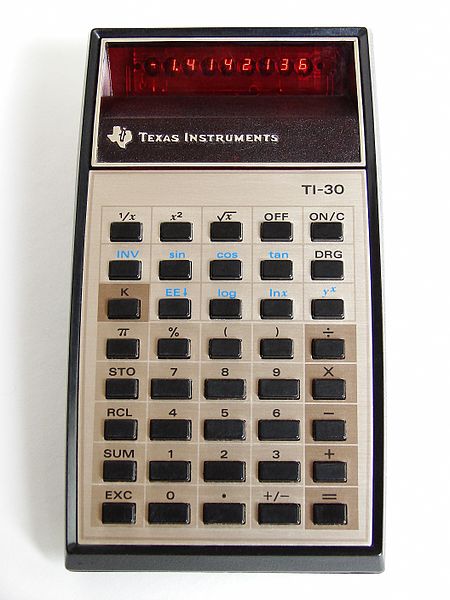
Texas TI-30 Scientific Pocket Calculator
Research on the web accredits American company Texas Instruments with the production of the first pocket calculator in the late 1960s but my first memory of them would have in the early 1970s. I saw one at a neighbour's house. It had very basic functions, addition, subtraction, multiplication and division. The cost at that time was as I recall, £20, an astronomical price then which cost about £240 in today's money. A great game at the time was to turn the calculator upside down and try to make words with the numbers showing upside down. By 1976 I had a Texas Instruments TI-30 scientific calculator. Prices were coming down by then and at £11 this seemed good value. I used it a lot, especially as I was in 3rd year of high school by then and doing O Grade maths and arithmetic. Compared to that first calculator, this was a much more sophisticated beast. Indeed such was its popularity that this has been seen as an iconic model and even now it looks quite modern I think.

The TI-30 was first introduced in 1976 so I must have got it soon after it was released. Having 17 different scientific functions including trigonometric and logarithmic, it was notable for its very low cost for the time and much less than the retail prices of other scientific calculators. This was produced until 1983. I seem to recall still using it after I left school and started higher education in 1980. Although he actual calculator has undergone several design revisions the TI-30 brand is still alive albeit and thus it remains an icon of its time.


Computers


When did I see my first computer? I think it would have been in my final (6th) year at high school on a trip to Kingsway Technical College in 1980. When I went on that year, to study at Dundee College of Technology, there was what was known then as a mainframe computer in the building. Basically a whole room was given over to powering a few VDUs which could display only letters or numbers on a bright green colour against a black background. I don't know how much memory they had but it was tiny compared to one average domestic computer now. Indeed it is said that today's home computers are more powerful than the computer used to send the Apollo spacecraft to the Moon.

Sinclair ZX Spectrum
In 1982 the movement towards having a computer in the home must have been started by the Sinclair ZX Spectrum computer. This was the creation of inventor and electronics boffin Clive Sinclair. Indeed the Timex watch factory in Dundee was where they were made. The computer was basically the size of a small keyboard and you connected it to the aerial input of a portable television. The Spectrum is remembered with fondness for its rubber keyboard. It had a colour display and you could run games on it which were stored on audio cassette. Depending on the size of the game you would have to wait several minutes while "loading" it onto the computer from your cassette player. This was a really popular machine which I learned to do some programming on in a language called BASIC. However the real attraction of this machine was the number of games you could buy. It could be regarded as the first games console because some games became very very popular. The games I remember most were Atic Atac (an arcade game) , Manic Miner (a platform game) and Chequered Flag (a racing simulator). Apparently over twenty three thousand games have been released for the Spectrum.

Listening to Music - From Vinyl to mp3

The developments in technology have equalled those of computers and transformed the way we listen to music. If you wanted to listen to high quality music then there was only one medium to choose and that was the gramophone record otherwise known as vinyl, because that's what it was made of, or more popularly, records. Armed with a decent hi-fi system (which was not cheap) and some well produced records (yes records not albums), the listen experience was second to none and some say that the quality of digital music still doesn't surpass this. In those days you needed a decent turntable (record player) fitted with a decent tonearm which was fitted with a decent cartridge (needle). Revolving at 33 1/3 rpm and at 12 inches in diameter, you placed the record on the turntable and lowered the needle gently onto the outer edge of the record. As the music played, the arm and needle retained its place in the groove of the record and slowly moved towards the centre of the record. Each record had two sides, and each side had a limit of about 25-30 minutes. Therefore one record gave you a listening experience of just under an hour.

Rega Planar 3 Turntable
Being mechanical, the tonearm was weighed, which meant that you wanted the needle to just sit on the record with enough force that it tracked the groove and didn't gouge it out by being too heavy. Too light however, and it would lift itself off the platter. This wasn't usually a problem but it did mean one thing, which was that record players didn't like vibrations and if people were dancing or jumping next to it, the needle would jump and the music would be unlistenable. The other disadvantage to records was that they got scratched easily and they also retained dust. This induced cracks, pops and crackle which would be very evident on playback, especially during quite passages. You therefore had to handle records with care, and avoid touching the actual surface of them as finger prints pressed the dust into the groove and cause crackles.

Philips Portable Cassette Player / Recorder

Cassette Tape
The cassette tape (or compact cassette as it was correctly called) was a small plastic case about the size of a mobile phone in which was contained magnetic tape. You inserted the cassette into the cassette player and pressed the play button. The tape then rotated across the playback head. Like vinyl there were two sides and at the end of the first side you removed the cassette and put it back in the machine the other way round. It was a good development because there were no such problems with crackles although the sound quality was poor compared with vinyl. Cassettes always had a background hiss which was evident between songs and at quiet passages. What cassettes did do however was introduce some portability into playing music. My first cassette player was a Philips portable which I got for Christmas, probably around the age of 13. It was perhaps slightly smaller than a sheet of A4 paper and it had a little speaker which produced reasonable volume. It wasn't Hi-Fi sound by any matter of means but it was good to be able to lug your music around. The invention of the Sony Walkman cassette players made cassettes truly portable. They were the mp3 players of their day.

Philips Compact Disc Player
compact discs

Move forward to 1983 and I'm in the second half of my degree course at Dundee College of Technology. The compact disc player appears in the shops for the first time. It's hard to believe that this media is now nearly thirty years old. CDs really kicked started the revolution in digital music. Playing music with superb clarity and with no background noise whatsoever, the CD was received with great enthusiasm. As more titles became available and the cost of CD players came down, the CD quickly replaced vinyl and the music medium of choice. The Sony Walkman abandoned cassettes and started producing CD Walkmans so that the same high quality listening experience could be heard on the move. You could even play CDs on your computer.

ipod nano
If the CD defines the eighties then it is mp3 that defines the nineties and beyond. Designed for the computer age, mp3 files were the first non-mechanical method for listening to music. Stored as digital data on a hard-drive or flash drive, mp3 has a low file size, meaning that you can store thousands of songs on a single device. The ability to share mp3 files on the internet meant that files "ripped" from CDs onto computer could be easily spread on the internet and file sharing sites such as Audio Galaxy and Napster soon became very popular. Free software mp3 players such as Winamp with interchangeable skins enhanced the overall experience by allowing you to create playlists. Portable hardware mp3 players soon followed, the most notable being the ipod, which quickly became the fashion device to be seen with.

The growth of mp3 and other similar digital music formats has now become mainstream. Unauthorised peer-to-peer files sharing networks (e.g. torrents) have spread to the extent that it has become difficult for the record industry to stop this activity. However files can be legally downloaded from download sites such as Amazon and eMusic and this is a popular method of music sales alongside CDs which continue to sell albeit to a reduced level. Today I listen to music stored either on my iphone or my computer. I have something in the region of thirteen thousand songs stored on an external hard drive which is no bigger than the size of one compact cassette. There is no noise, the sound quality is great and access to your favourite music is just seconds away.

Beyond storing your own mp3 files, streaming media has also become a popular way of listening music. In this model, the music is held by a streaming provider and, for a small monthly fee, you play the music through their own media player. You never own the music files, but you can listen to everything on the streaming provider's catalogue. Spotify is one of the most popular online services and you can choose from hundreds of thousands of tracks covering all music genres.

Tuesday, 9 August 2011

Creamola Foam, Kramola Fizz, Krakatoa Foamy Fruity Fizz

In my post of 31 October 2010 I reminisced about Creamola Foam:


Creamola Foam was a little tub of powder that, when mixed with water, turned into a fizzy fruit flavoured drink. Creamola Foam was the drink of choice for generations of children across Scotland who would enjoy making "big glasses" using the flavoured crystals and water. The drink originally came in Raspberry, Orange, and Lemon flavours and Cola was a later addition to the range. Creamola Foam became popular in Scotland from the 1950s onwards. After the grim days of austerity and rationing, having a fizzy drink you could mix yourself was quite a luxury and it remained popular. The production of the brand ceased in 1998, sparking a wave of disappointment and a growing campaign for its return ever since. The exact formula which made the sugary concoction so special was lost when production ceased in 1998, leaving would-be revivalists relying on nothing more than imprecise ingredient lists and recollections of how the drink tasted, looked and felt in the mouth. 

Alas a clone of Creamola Foam has yet to be realised.


In my post of 20 November I mentioned that my daughter got a tub of cola flavour Kramola Fizz from a family friend:


Well we happened to be in The Sweetie Shop in the Forum Centre today and my daughter noticed that they were selling tubs in different flavours though they were a bit pricey at £4 each. They do have little sachets for £1.50 though.


In the same shop the other day we got two tubs of Krakatoa Foamy Fruity Fizz in lemon/lime and raspberry flavours at £2.50 per tub. Not as fizzy as Creamola Foam but an improvement on Kramola Fizz.


Saturday, 25 June 2011

UK Leads On Drugs Deaths

I have periodically commented on here about the prevalence of drugs locally and the picture nationally and globally - see for example my posts from a year ago this month.

New figures show that the number of drug deaths in Britain is among highest in the world. Illegal substances killed 2,278 people in a year, according to the United Nations Office on Drugs and Crime. It ranks Britain sixth in the world, with only the US, Ukraine, the Russian Federation, Iran and Mexico having more.

Most of these deaths were caused by opioids, such as heroin, followed by sedatives, cocaine, amphetamine-type stimulants and ecstasy. The report also warned that, while drug use across the world remained stable, ‘demand soared for substances not under international control’ – so called legal highs. It added: ‘These markets continue to evolve and every year new products are manufactured to supply an increasingly diversified demand for psychoactive substances.’

The figures are from the year 2008 and the UN says drug deaths are recorded differently in different countries. The British deaths are among a population of 61 million and compare to 1,638 deaths in Spain, which has a population of 46 million, 1,449 in Germany (population 81 million) and 484 in Italy (population 60 million). The US, home to 308 million people, had 38,396 drug related deaths. Britain, the Russian Federation, Ukraine, Spain and Germany account for 80 per cent of all drug related deaths in Europe, the report shows.

Crime prevention minister Baroness Angela Browning said in the year to March officials seized 1,951 kg of cocaine or crack, 473 kg of heroin, and 1,012 kg of other class A drugs. ‘This report demonstrates the need for a renewed focus in dealing with the global drugs market to properly protect our communities,’ she added. Michael Linnell, from the drug and alcohol charity Lifeline, said he had seen a ‘dramatic’ fall in the number of young people taking heroin. He added: ‘Most of the people who are heroin addicts are in middle age and have been taking the drug for many years which takes its toll on their health and kills them. ‘But by far the biggest problem we face is from alcohol, both from the number of deaths and the impact it has on society.’

http://www.unodc.org/documents/data-and-analysis/WDR2011/World_Drug_Report_2011_ebook.pdf

In April The Guardian reported that the Government's expert drug advisers were to publish their first significant review of the harms caused by cocaine use this week to counter the "increasingly common" idea that it is a relatively safe drug. The increasing popularity of cocaine use among young adults in recent years has put Britain at the top of the European "league table" for cocaine abuse – a position it has held for six out of the last seven years.

Cocaine is the second most popular drug in Britain, after cannabis, with its use increasing markedly in the past decade from 0.6% of 16 to 59 year olds reporting use to the British Crime Survey to 2.4% in 2009-10. This is equivalent to nearly 800,000 people reporting that they have used it within the last year. Among those aged 16 to 24, the increase in use has been even sharper from 1.3% to 5.5% in 2009-10 – or about 367,000 teenagers and young adults.

The Advisory Council on the Misuse of Drugs (ACMD) wanted to launch its review of cocaine last year but was delayed by requests for advice from the home secretary, Theresa May, on banning the new generation of designer drugs or "legal highs" such as spice and mephedrone. The drug council chairman, Professor Les Iversen, recently wrote to the May telling her: "The ACMD has previously indicated that it would initiate a review of cocaine and that this review would be focused on the nature of the trade, its prevalence in the UK and the harms of the drug – not classification issues. "As you are aware, the substantial work the ACMD has undertaken on the legal highs agenda has prevented it from having resource to initiate this review, however, the ACMD is now in a position to start this with immediate effect." Iversen, who took over from Prof David Nutt after he was sacked, said that he was firmly of the view that cocaine is, and should remain, a class A drug. He said that the council has never looked at cocaine as a single substance in its 40 year history and the review was needed to reinforce public health work to reduce its harmful effects. It would tackle "the need to disabuse the misapprehension that cocaine is a relatively safe drug".

The decision to prioritise the cocaine review means that a similar investigation into the use of Qat, requested by the home secretary in February, is likely to be delayed. Qat is a leafy green plant whose leaves are chewed and used as a stimulant principally among Britain's Somali community. The drug advisers are also finalising their official advice on the wider implications of the emergence of the "legal highs" phenomenon and make further recommendations for tackling suppliers and reducing market demand.

Thursday, 16 June 2011

A Hebridean Curry

Pouring over holiday brochures for sunny and hot climes is a ritual enjoyed by many in this country, and sometimes more than once a year these days. A combination of lack of money and an inbuilt suspicion of packaged holidays has meant that this is not a ritual I have taken part in very often. Holidays are not something I've had a lot of.

However a recent two nights and one night excursion to the Isle of Skye and Glencoe respectively leads me to think that I must get away more. I have seen them before but I think I must see more of Scotland. I've been to Skye and Glencoe before many many years ago, but the scenery never fails to astonish and evoke awe. For sure you have to consider that rain is very likely but it only adds to the atmosphere. They are simply the most stunning of landscapes, on our very own doorstep.

At times you are looking at a scene that has been gazed at for thousands of years. A mountain that looks as if it harbours infinite secrets - the majestic, perfect shape of Buchaille Etive Mhor on the road to Glencoe. In Glencoe itself one cannot ignore the story of the Government sponsored assassination of the McDonald clan in 1692. The Glen is dark, heavy and foreboding and over 300 years later it feels as if the Glen's very pores still ooze the tragedy in a tone of lamentation.


The Clachaig Inn claims to have been in Glencoe for over 300 years therefore it may well have opened it's doors to the warring clansmen. Catering much to the walkers and climbers but very welcoming to the sight seeing tourists, one cannot imagine an Inn with more dramatic surroundings. This was a place with a warm atmosphere, a great selection of beers at non tourist prices and pub meals, which while slightly pricey were of really good quality. The Inn appears to work really hard at creating an identity. It provides a wealth of information about the local area from its website . It is linked to CAMRA (real-ale) and it has regular live music playing one of the bars.

Glencoe appeals to walkers, climbers and tourists alike. The Isle of Skye does so too but with a greater emphasis on the capital T of tourism. Perhaps its island remoteness makes this all the more necessary but the twists and turns of Skye's roads are adequately dotted with the cottages of the B&B trade. The towns of Skye (mainly Broadford and its "capital", Portree) are adeptly focussed on the tourist experience, with craft shops, art galleries, boat trips, accommodation and of course the all important pubs and restaurants. I say restaurants. Some of them were offering pub grub at restaurants prices, which in real money was basically about twice the price of an equivalent pub meal in Dundee. Of course Skye also has its fair share of highly regarded restaurants, not least the Three Chimneys and Lady Claire MacDonald's Kinloch Lodge.

A real find was "The Prince of India" in Portree. I could not believe that there was a curry house on Skye! Yet there it was offering an array curries well known to any curry fanatic. The Chicken Jalfrezi and a Balti Chicken Madras at our table were of a pretty good quality and they would have beaten many a Dundee curry house hands down. There's a lot to be said for eating Indian in the Inner Hebrides.

Tuesday, 31 May 2011

The Howff

The Howff Cemetery sits in the City Centre in a square surrounded by four streets. Two of the streets' buildings back onto the cemetery whilst the other two provide a view into the cemetery. The Howff is no Pere Lachaise. It is tiny in comparison and it cannot boast the likes of Jim Morrison or Edith Piaf amongst its residents. However the Howff holds its own as the only remaining inner city cemetery left in Dundee and is locally immortalised in history as the place where the 7 incorporated trades held their meetings in the middle ages.

These have long ceased. The 18th and 19th century gravestones stand in varying degrees of opulence and disrepair. Earlier gravestones have long since shed their identities. They stand in solitude alongside the delightful trees, bushes and flowers that are tended by our local parks department.

The Howff represents an oasis in the heart of the City. Sitting on one of the benches I am able to forget that I am in Dundee. You do not feel that you are in the City Centre. On a sunny day I could be anywhere - Edinburgh, York, Bath, Paris. It is the calm beauty that permeates and takes one away into another world.

Friday, 27 May 2011

2011 - The Planking Year


A bit of fun, but risks of planking craze should not be taken lying down. A surreal internet craze that led to the death of a man in Australia this month is sweeping across Dundee. Planking involves a person lying face down in front of, or on, an unusual object or public place and then uploading a picture of the scene to the internet.

A Facebook group called Planking Dundee had nearly 2700 followers this morning. Although many of the photographs are intended to be humorous — such as a squad of painters and decorators all planking over pasting tables — others pose on dangerous, difficult-to-reach locations.

The Planking Dundee page also contains photos of people planking on a pillar outside Dundee Sheriff Court, on car roofs, post boxes and even on top of wheelie bins. Others have opted to plank on landmarks such as the statue on Riverside Drive. However, some people have risked serious injury or even their lives by posing for photos on third-storey windowsills, on roofs and even on top of chimneys.

Safety campaigners issued warnings about the risks of the fad earlier this week after pictures appeared online of a Sunderland man planking on the Wear Bridge. This month Australian Acton Beale died after falling from a seventh-floor balcony in Brisbane after trying to plank on its railings. The accident even prompted Australian Prime Minister Julia Gillard to call for a ban on planking. A spokesman for the Scottish Ambulance Service said nobody should risk their life for a fad.

"We would always have concerns if people are putting themselves in harm's way, especially for a craze," he said. "We would have to deal with any incident but if people are putting themselves at risk then we would be concerned about the potential increase in ambulance calls."

Tuesday, 24 May 2011

Extreme Weather Continues


Scotland continues to have its fair share of extreme weather. Following on from the worst winter snow for many a year we were transfixed as a tree in the Howff Cemetery threatened to topple. Elsewhere gale force winds of up to 100 mph left commuters stranded as power cables and trees blocked roads and overhead cables on the rail network were interrupted due to falling debris. The Tay and Forth Road Bridges were closed as were major tourist attractions including Edinburgh Zoo, Stirling Castle and the Falkrik Wheel.

The winds, which reached nearly 80mph, caused damage across the city. Several people watched in horror as trees were uprooted and crashed against their homes or on to vehicles. The Tay Road Bridge was closed while several other main routes around the city, including parts of the Kingsway, had to be closed temporarily due to fallen trees and branches. Police said they received dozens of calls within half an hour as the winds peaked shortly after 2pm.

Part of the roof of the Bay View Bar in Earn Crescent, Menzieshill, blew off after 5pm, striking a woman who was walking in the area. She was taken to Ninewells Hospital with neck and back injuries. Her condition was not known last night but when taken into the ambulance she was breathing and conscious.

The storm blew a piece of metal railing from a building on to a taxi in Meadowside, narrowly missing a pedestrian. The three-foot L-shaped corner section plunged on to the vehicle, causing significant damage.

Part of High Street in Dundee was cordoned off as a precaution as the wind blew sections of roofing from several buildings. Perth Road at Seafield Road was also closed last night after a chimney pot fell from the roof of a tenement building on to a bus shelter. Firefighters raced to the scene and removed other chimney pots that were loose and in danger of falling.

In Albany Terrace an 80-foot tree was uprooted completely, blocking the road and causing extensive damage to two cars parked on the opposite side of the road. Trevor White's Fiat Punto was badly damaged by the fallen tree and he said it was lucky nobody had been killed." I was working at home in the back of the house when I heard the crash. I originally thought something had fallen at the back but couldn't see anything then somebody came to the door to tell me that my car was damaged," he said. Another large tree blocked Constitution Road after being blown over there.

Elsewhere in Dundee, Graeme Paul had a lucky escape as he dodged out of the way of a falling 50ft tree with just seconds to spare. The Broughty Ferry Road resident had gone to warn his neighbours Helen and Mike Lukas that a tree near their house was in danger of toppling. However, as he was ringing the doorbell, the tree fell on to the house. Luckily, Mr Paul was able to scramble out of the way and escape injury. He said, "They've been quite lucky it hasn't damaged the house more. Last year a tree came down and blocked the road but these are the worst winds we've had since we moved here eight years ago." Although the tree fell against the side of the house, it does not appear to have caused any major damage. Mrs Lukas said, "Obviously some of the slates have come off and the rhones are damaged but all the windows are secure. We were both at home. It happened very quickly and it was quite a crash — I've never heard such a loud noise."

Shabana Yaqub (22), of Lammerton Terrace, saw her Peugeot crushed by another falling tree. "I was about to go to work when I saw the tree had fallen. I knew I had parked my car there and I hoped it would have missed but it hadn't. Luckily, it doesn't seem too badly damaged but the car across the road has been."

Sheila Morely, from Dawson Road, returned home to a nasty surprise. "I got home about 2pm and found a tree from the college and blown over and demolished the car port," she said. "It's resting on top of the garage roof but we don't how much damage has been done."

Menzieshill residents Francis Quinn (70) and Irene Gray (65) escaped serious injury after a 40ft tree plunged into their Dickson Avenue home. The couple's patio doors were smashed and a garden wall was knocked down. Mr Quinn, who is retired, said he initially thought the deafening crash was a loud boom of thunder. "I was just in the kitchen and my partner was sitting in the living room watching the television when the tree came crashing down," he said. "It has broken my patio windows, and the wall has been knocked down and all the stuff on the patio has been damaged. I heard the crash and I really thought it was thunder but then I heard my partner shouting and screaming."

The Met Office recorder at Glenogil in Angus saw wind speeds of 79mph and winds are expected to reach 40 to 50mph today. A spokesman for the Met Office said, "There were severe gales across the area, reaching speeds of up to 70mph and even more on the Tay Bridge. Winds will be fresh and strong on Tuesday but nothing like as bad."